
University Heights: From Scrubland to Streetcar Suburb
From Boom to Bust
San Diego did not really start to grow until 1885 when the transcontinental railroad reached the city. Prior to that, the population of San Diego was about 2,647 and most people arrived in San Diego by ship. From the Pacific Coast Steamship wharf, horse-drawn streetcars carried passengers to the commercial core now known as the Gaslamp District.
Railroad rate wars sparked a real estate stampede that boosted the city’s population to an estimated peak of 35,000 to 40,000 by 1887. Chaos and frenzy swirled around San Diego’s transit scene between the mid-1880s and the early 1890s. With the land boom in full swing, franchises were handed out indiscriminately.
Several speculative real estate developments were also planned during this time including University Heights. However, the land boom collapsed by 1890 and the city’s population dropped to 16,000. Many planned developments, including University Heights, failed to materialize and the fledgling transit companies could not survive.
San Diego’s economy began to turn around in the late 1880s around when John D. Spreckels, a wealthy industrialist from San Francisco, began investing in San Diego infrastructure. In 1891, he formed the San Diego Electric Railway Company (SDERy), bought and consolidated several of San Diego's failed or failing transportation lines, and began a process of massive expansion.
Early Streetcar Lines in University Heights
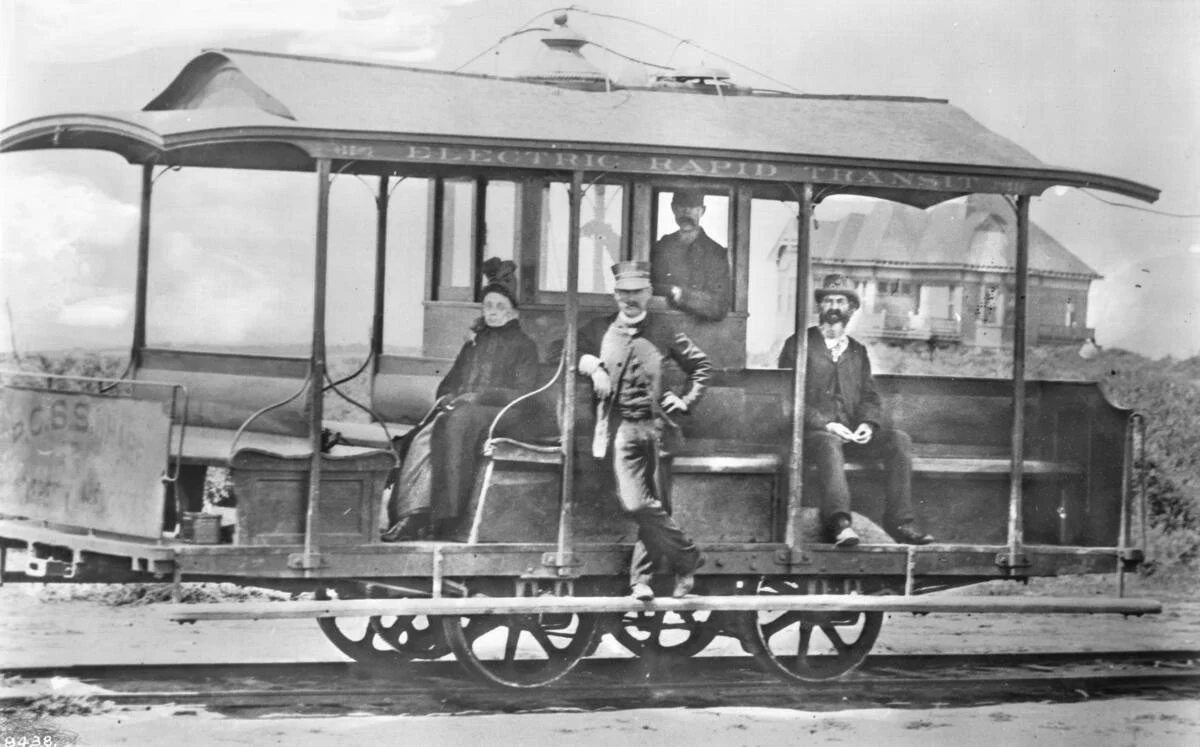
Electric Rapid Transit, circa 1888. Source: USC Libraries.
As streets were graded, water and sewer lines established, and lots offered for sale in University Heights, the Electric Rapid Transit (ERT) extended its electrified cable car in 1888 from downtown San Diego up Fourth Street to University Avenue (now Normal Street) and then up Park Boulevard to University Heights.
However, the ERT experienced difficulties right from the start, including frequent shutdowns, various alterations and repairs, an oil shortage, and legal battles. And so, by 1889, the line closed.
That year, the San Diego Cable Railway Company organized using leftover assets from the ERT and developed a five-acre park in 1890 called “The Bluffs” at the end of the rail line at Park Blvd. and Adams Avenue in University Heights to increase ridership. However, due to a series of financial setbacks, the Cable Railway Company was also forced to shut down in 1891 after just 13 months of operation.
The Cable Railway Company was then bought by George Kerper in 1895, who reorganized it into the Citizens Traction Company. Kerper electrified the rail line and renamed The Bluffs to Mission Cliff Park. Unfortunately, the Citizens Traction Company also went into receivership in 1898 during the height of a nationwide depression.
Another short-lived line was the Park Belt Motor Road, also known as the City & University Heights Railroad, and the University Heights Motor Road. It was built to lure buyers to real estate developments from a terminal at 18th and A. The 10-mile line traveled circuitously through City Park (Balboa Park today) and Switzer Canyon to what is now Marlborough Street before heading back downtown via Fifth Street. It opened July 7, 1888, but went into receivership about a year later and shut down.
Expansion of Streetcar Lines by San Diego Electric Railway
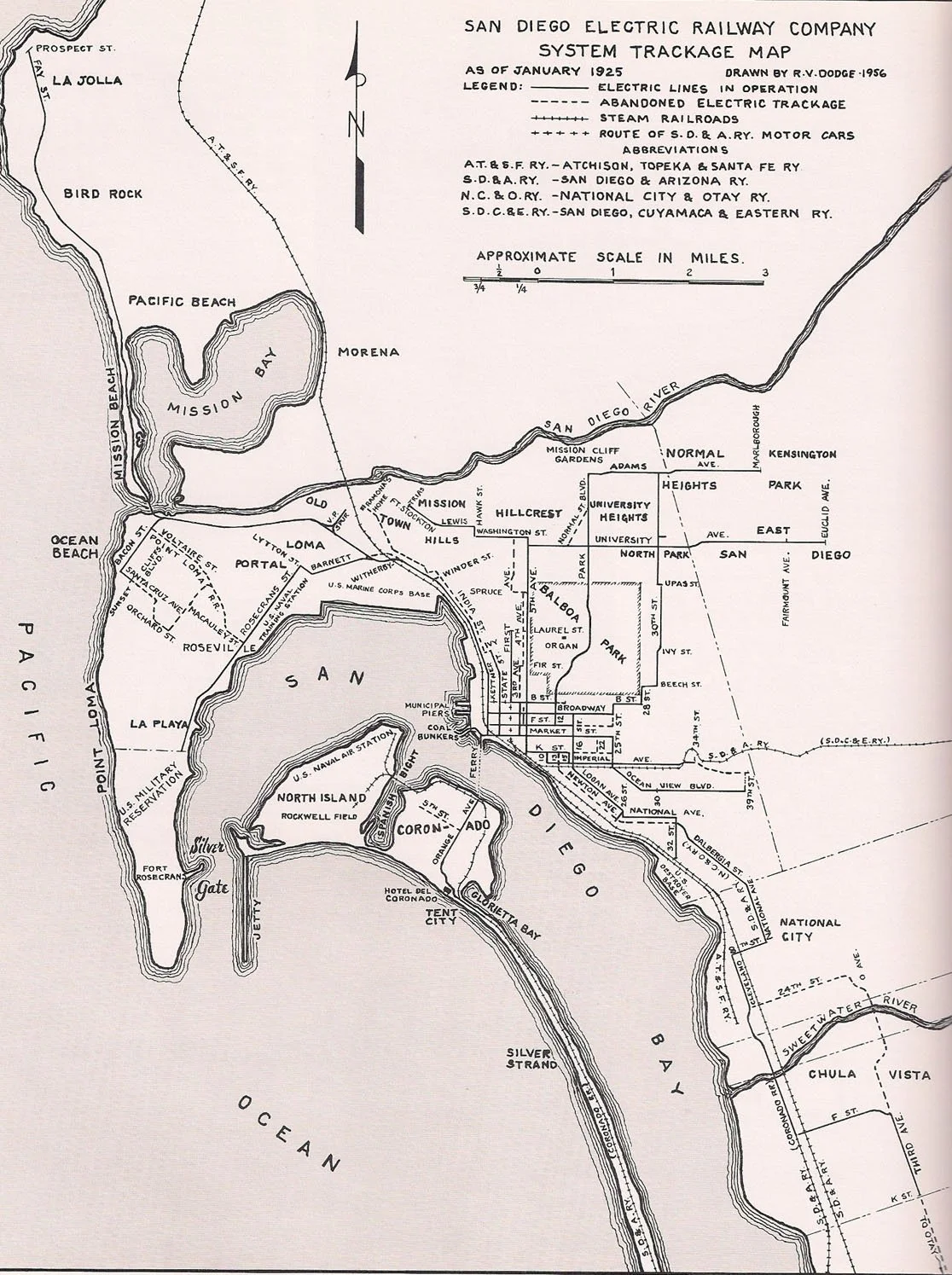
San Diego Electric Railway Route Map, 1925. Source: Rails of the Silver Gate by Richard V. Dodge, 1960.
In 1891, John Spreckels formed the San Diego Electric Railway (SDERy) and started buying and consolidating several of San Diego’s failed or failing transportation lines including the ERT, San Diego Cable Railway, Park Motor Belt, and Citizens Traction Company.
A large expansion of the SDERy system began in 1904 and by 1910, the SDERy was the only remaining trolley operator in San Diego, covering over 165 miles of track from La Jolla to Chula Vista. The new railway routes extended into barren scrubland and paved the way for the streetcar suburbs of University Heights, North Park, Hillcrest, and Mission Hills.
After the real estate bust of the 1880s, University Heights began to grow again in 1907 when the SDERy extended streetcar service east from Park Blvd. along Adams Avenue.
Making Tracks to University Heights
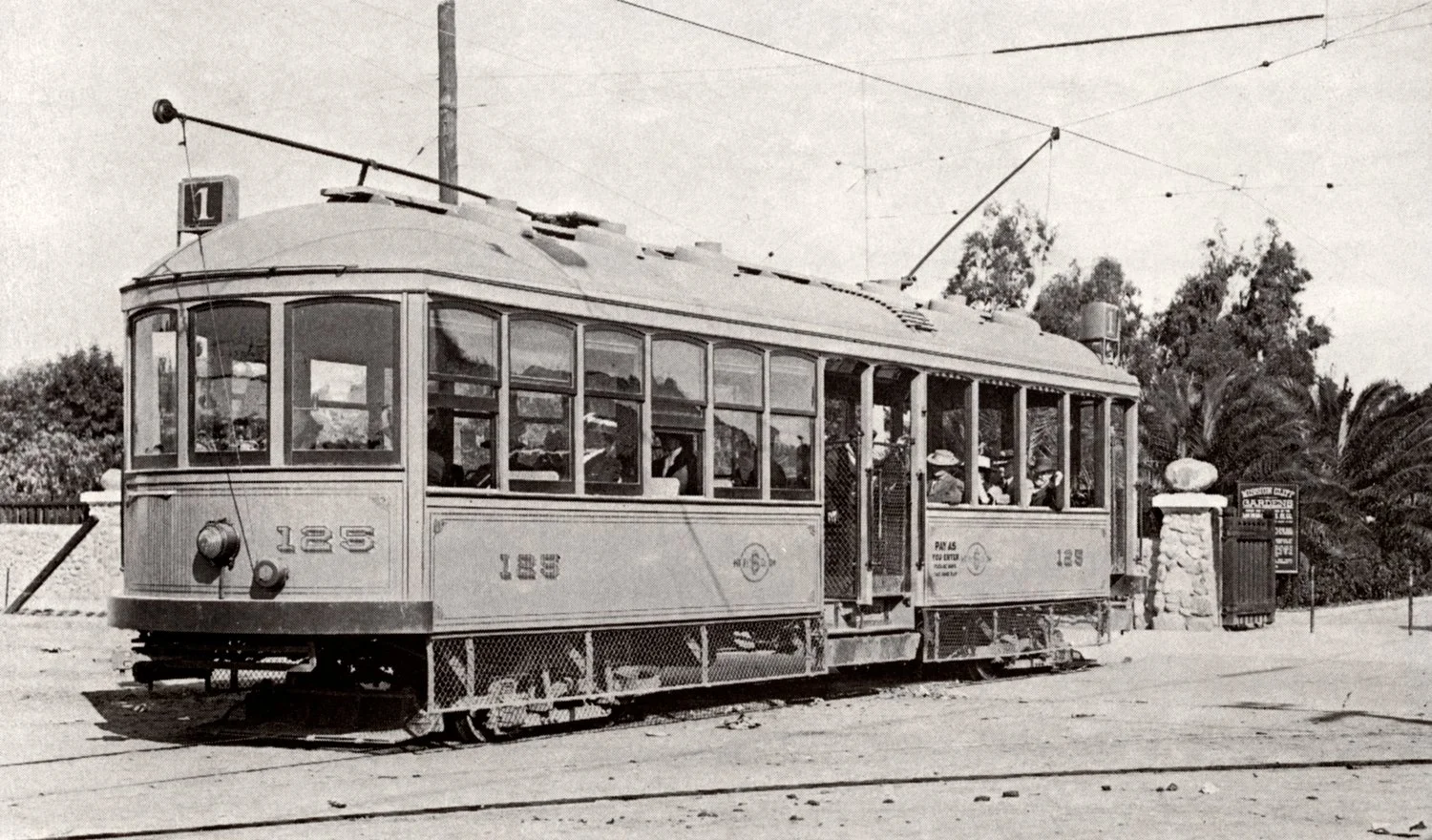
SDERy Car No. 125 on Route 1 at Mission Cliff Gardens, circa 1912. Source: San Diego History Center.
Several SDERy routes traveled to or near University Heights:
The Fifth Avenue and Logan Heights Line began service from downtown to Mission Cliff Gardens in University Heights in 1907 and was assigned the route number 1 in 1910. The car traveled north from downtown on 5th St. (now 5th Ave.) to University Ave., to Park Blvd. to the Normal School, and continued up Park Blvd. to Mission Cliff Gardens and the Ostrich Farm.
The Adams Avenue Line also began service in 1907 traveling east on Adams Avenue from Park Blvd. to Marlborough Drive. In 1917, it was assigned the route number 11 and traveled north from downtown on Third Ave., to B St., to 12th Ave., through (Balboa) Park, to Indiana St., to Park Blvd., to Adams Ave. to Kensington Park.
Also in 1917, the East San Diego Line via Park (Route 7) was begun which extended from the Exposition Terminal to Laurel St., to Indiana St., to Park Blvd., to University Ave., to Euclid Ave. in East San Diego.
In 1913, the San Diego Electric Railway built a massive trolley car barn on Adams Avenue at Florida Street. The cavernous reinforced concrete building was used to store and perform minor service to several hundred trolleys that entered and exited the carbarn through a series of switches off Florida Street.
Decline and Demise of Streetcar System
By the 1930s, streetcars were losing business to city buses and private automobiles. In 1948, Jesse L. Haugh purchased the San Diego Electric Railway Company from the Spreckels interests and changed the name to San Diego Transit System. San Diego became the first major California city to convert to an all-bus transit system.
And so, on April 24, 1949, at 5:35 a.m., N.A. Holmquist, the most senior operator at San Diego Transit, drove car # 446 into the Adams Avenue trolley car barn, ending rail transit in San Diego.
Streetcar Legacy Lives On
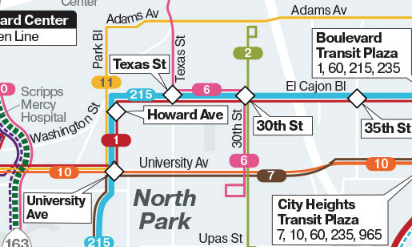
MTS Regional Transit Map
The legacy of the streetcar system in University Heights lives on in MTS bus routes 7 and 11 which follow at least part of the old streetcar routes. In addition, the site of the Adams Avenue Carbarn was also historically designated and transformed by community efforts into today’s Trolley Barn Park.
References
Dodge, Richard V. Rails of the Silver Gate: The Spreckels San Diego Empire. San Marino, CA: Golden West Books, 1960.
Holle, Gena. Transit in San Diego: ASCE Anniversary Project. Journal of San Diego History, Volume 48, Number 1: Winter 2002. San Diego Historical Society.
Mengers, Douglas W. Images of Rail: San Diego Trolleys. Arcadia Publications, 2017.
San Diego History Center. Timeline of San Diego History: 1880-1899.
University Heights Historical Society. Cable Cars and Ostrich Feathers: A Self-Guided Walking Tour of Historic University Heights. San Diego, CA: Save Our Heritage Organization, 2006.